
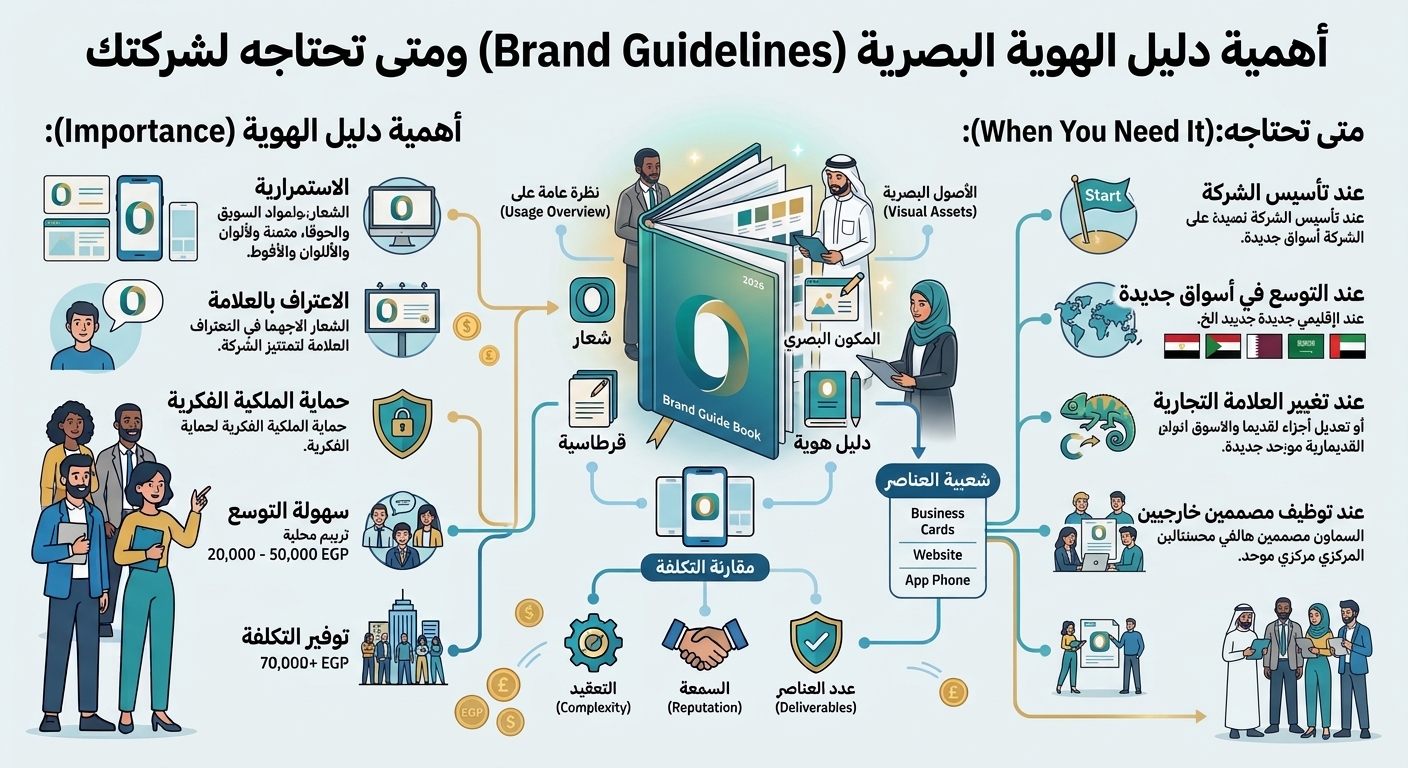
Why Your Company Needs a Brand Guidelines Manual (And When)
The Missing Corporate Constitution: What Happens When Designers Operate Without Rules?
Imagine you founded a thriving enterprise, investing heavily in a stunning logo and creative brand assets. Months later, you hire a new marketing manager, contract a new print shop for stationery, and partner with an independent web developer.
Instead of handing them a structured, standardized rulebook, you leave them to guess your brand specifications. The result two weeks later?
The new designer uses a completely different shade of blue. The print shop outputs distorted logos pressed against paper edges. The web developer applies unapproved fonts entirely disconnected from your brand identity!
This destructive operational chaos is the inevitable consequence of missing the most critical document in any successful organization: "The Brand Guidelines Manual."
In this in-depth guide by Osol Digital Agency, we explore why a Brand Guidelines book serves as the ultimate defensive shield protecting your corporate digital and commercial assets from distortion.
What Is a Brand Guidelines Manual?
Simply put, a Brand Guidelines manual is **"the official corporate constitution or Brand Bible."**
It is a detailed technical and artistic document dictating precisely how your company's visual assets must be handled across every medium and touchpoint. It eliminates subjective guesswork, answering every potential question faced by designers, developers, or marketers interacting with your brand.
When commissioning Visual & Corporate Identity Design Services from Osol Digital Agency, we deliver this invaluable master operational asset alongside your core visual system.
What Does a Comprehensive Brand Guidelines Book Contain?
Brand books range from 15 pages for lean startups to over 100 pages for enterprise corporations, covering the following core chapters:
- 1. Logo Usage & Clear Space Rules:
The manual establishes mandatory empty space surrounding the logo to prevent visual crowding, alongside minimum scaling limits for digital screens and physical print formats. - 2. Unauthorized Usage Parameters (Logo Don'ts):
A visual reference guide displaying prohibited applications, such as stretching proportions, altering colors arbitrarily, tilting angles, or placing marks on low-contrast backgrounds. - 3. Precision Color Specifications:
Defining brand color hues with absolute accuracy across four primary color spaces:- RGB: For digital screens and software UIs.
- CMYK: For offset and digital paper printing.
- HEX: For web development and portals.
- Pantone: For specialized manufacturing, fabric, and merchandise production.
- 4. Typography Architecture & Hierarchy:
Specifying primary header fonts, body copy scales, and official commercial licensing links for both Arabic and English typography. - 5. Tone of Voice & Brand Archetype:
Establishing whether corporate communications are formal and authoritative or approachable and dynamic, guiding copywriters on messaging parameters.
Why Your Enterprise Needs It Immediately (Economic & Operational ROI)
Investing in a robust Brand Guidelines manual saves enterprises thousands of dollars through key operational advantages:
1. Eliminating Expensive Print Errors & Reprints
Printing 5,000 business cards or product packaging runs with incorrect color profiles forces you to scrap the entire batch, resulting in heavy financial losses. A brand book eliminates these errors by supplying print shops with turnkey specifications.
2. Protecting Brand Consistency & Market Equity
Visual consistency builds customer familiarity and subconscious trust. The brand book ensures target audiences experience identical prestige and professionalism across all touchpoints, boosting perceived value.
3. Accelerating Onboarding for Marketing Teams & New Hires
Instead of spending weeks explaining design rules to new staff, handing over the Brand Guidelines PDF equips them with complete operational rules instantly.
Frequently Asked Questions
Can we update our Brand Guidelines manual as our business scales?
Absolutely. As companies expand into new product lines or sub-brands, brand books can be updated to integrate new modular assets under the primary visual architecture.
Are Brand Guidelines manuals exclusively for large enterprises?
On the contrary! Early-stage startups benefit the most from brand books, establishing structured consistency from day one to avoid chaotic ad-hoc design habits.